Thursday, 21 October 2021

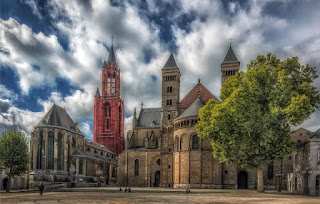
In the city of Masstricht, Netherlands

 “Thus I am in Holland, the kingdom of things, great principality of objects. In Dutch, schoen means beautiful and at the same time clean, as if neatness was raised to the dignity of a virtue.” ― Zbigniew Herbert

==================================================================

(in Holland, on the western coast of the Netherlands) Holland constitutes the flat, low-lying northwestern portion of the Netherlands. Touching Belgium on its west and quite close to Germany, Maastricht (featured here) is the capital of Limburg, Holland’s southernmost region. A city rich in history and culture, Maastricht boasts two great town squares: Vrijthof, with Sint-Servaas Church, Sint-Jan's Cathedral, and many cafes and restaurants; and Markt, home to the Town Hall and a popular vendor market. The city’s Old Town fortifications, are another big attraction. Maastricht is found along the Meuse (Maas) River at the junction of the Juliana, Liège-Maastricht, and Zuid-Willems canals. Now the main principal city in the southeastern area of the Netherlands, Maastricht was the site of the Roman settlement Trajectum ad Mosam (“Ford on the Meuse”) and later the seat of a bishop. from 382 to 721. The town was held by the dukes of Brabant after 1204, coming under the joint sovereignty of Brabant and the prince-bishops of Liège in 1284, and of Liège and the Dutch Estates-General in 1632. It was taken by the Spanish in 1579, by Prince Frederick Henry of Orange in 1632, and by the French in 1673, 1748, and 1794, but it resisted the Belgians in 1830–32. Portions of its old fortifications have survived. Attacked on the first day of the German invasion of the Low Countries in 1940, Maastricht was the first Dutch town to be liberated, in 1944. Following a 1991 meeting of the European Communities that was held in Maastricht, an accord (known as the Maastricht Treaty) was signed calling for the establishment of a European Union, with common policies on economics, foreign affairs, security, and immigration. Maastricht’s landmarks include the St. Servatius Bridge over the Meuse; the Dinghuis, or former courthouse; and the Town Hall. The cathedral, dedicated to St. Servatius, was founded by Bishop Monulphus in the 6th century; it is the oldest church in The Netherlands. The Protestant Church of St. John, with its 75-meter tower, originally served as its parish church. The Church of Our Lady has remnants of 10th-century crypts. There are many other medieval churches, as well as fine houses in regional Renaissance and French styles. Maastricht is also the site of the University of Limburg, a music conservatory, a symphony orchestra, art academies, and several museums. To the south are the sandstone (marl) quarries of St. Pietersberg, comprising more than 200 miles (322 km) of underground passages worked from Roman times to the 19th century. They served to hide peasants and cattle during the wars with Spain and art treasures and refugees during World War II.


In the capital city of Tallin, in the Republic of Estonia

 “In every port in the world, at least two Estonians can be found.” -- Ernest Hemingway, To Have and Have Not

===================================================================

(in the Republic of Estonia) The northernmost of the three Baltic states. Estonia’s area includes some 1,500 islands and islets; the two largest islands, Saaremaa and Hiiumaa, are off mainland Estonia’s west coast. Estonia has been dominated by foreign powers through much of its history. In 1940 it was incorporated into the U.S.S.R. and remained a Soviet republic until 1991, when (along with the other Baltic states) it declared its independence. UN-membership followed shortly thereafter, and Estonia soon transformed its government into a parliamentary democracy, while reorienting its economy toward market capitalism. It sought integration with greater Europe and in 2004 joined the North Atlantic Treaty Organization (NATO) and the European Union (EU). With a newfound confidence, singular Estonia has abandoned Soviet control and leaped into the arms of Europe. The attraction is mutual. Europe has embraced the charms of Tallinn (featured here) and its UNESCO-protected Old Town. Today, Tallinn (the capital of Estonia) s now one of Europe's most captivating cities. The country's sparsely populated countryside and extensive swathes of forest provide spiritual sustenance for nature-lovers from across the continent. The city of Tallinn is found on Tallinn Bay, part of the Gulf of Finland. A fortified settlement existed here from the late 1st millennium BCE until the 10th–11th century CE, and a town occupied this site in the 12th century, though it was soon captured by the Danes (in 1219), who built a new fortress on Toompea hill. Trade flourished, especially after Tallinn joined the Hanseatic League in the 13th century. In 1346 it was sold to the Teutonic Knights, and on the dissolution of their order in 1561 it passed to Sweden. Peter I (the Great) captured Tallinn in 1710, and it remained a Russian city until it became the capital of independent Estonia from 1918 to 1940, after which it was annexed to the USSR from 1940 to 1991. The city was occupied by German forces from 1941 to 1944 and was severely damaged. After Estonia declared independence in 1991, Tallinn became the capital of the newly independent state. Many relics of Tallinn’s long history survive (or have been restored), especially on Toompea hill and in the old, walled Lower Town. They include the 13th-century Toom Church, the Gothic Oleviste and Niguliste churches, the Great Guildhall of 1410, the 14th-century Rathus, and much of the old castle. Today, Tallinn is a major commercial and fishing port and industrial center. Machine building and shipbuilding head a range of engineering industries, and many consumer goods are produced here. The cultural center of Estonia, Tallinn has an academy of sciences; polytechnic, fine-arts, and teacher-training institutes; a music conservatory; and, several theatres and museums.


In the historical town of Zadar, in southwestern Croatia

 "The biggest challenge to life in Croatia is hope…. It’s as if there is some vague force of darkness trying to eclipse even the thinnest rays of optimism…. And while hope in Croatia is hard, its absence is offset by the strong personal relationships that tie individuals to the broader society. In Croatia it can be hopeless, but you never feel alone." -- Cody McClain Brown

=================================================================

(in the oldest continuously inhabited Croatian city) Zadar, a historical town in southwestern Croatia (and the former capital of Dalmatia), is found on the end of a low-lying peninsula that is separated by the Zadar Channel from the islands of Ugljan and Pašman. The inlet between the peninsula and the mainland creates a natural deep water harbor. Its Old Town on the peninsula dates from the 9th century BCE, when it was a Liburnian settlement called Jadera. The town became Roman in the 1st century BCE. Spared during the Avar and Slavic invasions of Dalmatia (5th–6th century CE), it remained a thriving commercial, cultural, and artistic center of Byzantine Dalmatia. Between 1045 and 1358 the town was intermittently at war with Venice, and in 1409 it was sold to Venice. It withstood a Turkish attack in 1571, and in the succeeding period Zadar became the most heavily fortified town on the Adriatic Sea, until its fortifications were partly demolished in the late 19th century. The town was an Austrian possession from 1797 to 1920, except for a brief French interregnum between 1808 and 1813. By the Treaty of Rapallo (in 1920), Zadar became Italian, thereby losing further ground to Split as the chief town of Dalmatia. During the course of World War II, Allied bombing destroyed 75 percent of Zadar’s buildings and damaged the port facilities. Liberated in 1944, it became part of Yugoslavia. Most new construction has taken place on the mainland. The Zadar Riviera is a developing resort center for water sports. The town has excellent road, rail, air, and ferry connections with the rest of the Balkan region and with Italy. Old Zadar is especially noted for the many fine churches that survived the air raids during World War II, as did the Roman forum and several of the old, narrow cobbled streets. St. Donat’s remarkable circular church (included in this photo) dates from the 9th century; the 11th-century St. Mary’s Church has one of the most important church treasuries in Croatia; and the Romanesque Church of St. Krševan was consecrated in 1175. There are also the 13th-century Cathedral of St. Stošija (Anastasia), the largest and finest Romanesque church in Dalmatia, and the 13th-century Franciscan church and monastery. Zadar also has an archaeological museum, the state archives, a theater, and a branch of the University of Zagreb. With its Roman ruins, art installations, and white-sand beach, Zadar is now one of the most unique resorts along Croatia’s Dalmatian coast, where in-the-know travelers come to feast on seafood, watch dreamy sunsets, and sip cocktails at oceanside bars.


In the city of Lugo, in the autonomous community of Galicia, northwestern Spain

 “There is of course a deep spiritual need, which the pilgrimage seems to satisfy, particularly for those hardy enough to tackle the journey on foot.” ― Edwin Mullins, The Pilgrimage to Santiago

===================================================================

(in northwestern Spain) The city of Lugo, capital of Lugo province in the autonomous community of Galicia, northwestern Spain, is found on the Miño River, southeast of A Coruña. Lugo originated as the Roman Lucus Augusti, and its Roman walls, which were added to UNESCO’s World Heritage List in 2000, remain a public walkway. The city was occupied by Suebi (Suevi), Moors, and Normans and was recaptured by King Alfonso III of Asturias and Leon in the 10th century. Notable landmarks include the Gothic Church of San Francisco, the cloister of which is a national monument, and the 12th-century Romanesque cathedral, with Gothic, Baroque, and Neoclassical additions. Lugo is the only city in the world to be surrounded by completely intact Roman walls, which reach a height of 10 to 15 meters along a 2,117-meter circuit ringed with dozens of towers. The walk along the top is continuous round the circuit, and features ten gates. Like Santiago de Compostela, Lugo has been a pilgrimage destination since the Middle Ages. The "Camino Primitivo," which forms a part of the Camino de Santiago (St. James Way), starts in Oviedo, then leads to Lugo and south to Santiago de Compostela. This route has become very popular in recent years because it is less crowded than other alternatives. Conquered from the Celts in the 13th century BCE by the Romans, Lugo became the most crucial town in Hispania Tarraconensis, not least because of its rich gold mines, which were quite active in Roman times. During their many centuries of rule, the Romans left famous monuments, among them the bridge over the Minho. Repaired and restored many times, the six elegant arches still cross the river and are particularly attractive when illuminated from below at night. Not far from the wall and the city center, visitors can enjoy Lugo’s largest park, named after Rosalia de Castro, Galicia’s most famous poetess. Her favorite flower was the camellia, which is also the national flower of Galicia. The park covers 61 acres (~25 hectares), with a lovely pond in the middle. Walkways, lookouts over the river, a play area for children, and plenty of flowers and trees (like redwood conifers, magnolias, and camellias) make for a quiet respite from exploring the city. For a glimpse of the luxury and splendor in which wealthy Romans lived, head to the center of the Old Town and visit the underground remains of an ancient villa, known as the Domus Oceani, or the House of Mosaics. (Colorful mosaics that cover floor and walls remain fresh and intact.)


In the region of Provence, southeastern France

 Lavender was used as a bath additive in regions like Persia, Rome, and Ancient Greece. These cultures believed that lavender helped to purify the body and mind. Today, lavender flowers symbolize spirituality, purity, silence, love, grace, serenity, and calmness.

=================================================================

(in southeastern France) Provence is a geographical region and historical province of southeastern France, which extends from the left bank of the lower Rhône River to the Italian border; it is bounded by the Mediterranean Sea to the south. It largely corresponds with the modern administrative region of Provence-Alpes-Côte d'Azur and includes the departments of Var, Bouches-du-Rhône, Alpes-de-Haute-Provence, as well as parts of Alpes-Maritimes and Vaucluse. The largest city of the region is Marseille. The Romans made this region their first province beyond the Alps and called it Provincia Romana, which evolved into the present name. Until 1481 it was ruled by the Counts of Provence from their capital in Aix-en-Provence, then became a province of the Kings of France. While it has been part of France for more than five hundred years, it still retains a distinct cultural and linguistic identity, particularly in the interior of the region. Lavender fields in France are found in Provence, on the Valensole Plateau that stretches over an area of 800 square kilometers (~309 square miles) covered with beautiful flowers. The Plateau is situated in the south of the Alpes-de-Haute-Provence and near the Verdon Gorges – France’s "Grand Canyon." There are several charming villages that you can visit on a day trip while you are visiting lavender fields. If you are staying in Aix-en-Provence, you will find it to be a great base for exploring much of Provence, its Lavender Fields, and the Gorges du Verdon. Provence seems to be nearly everyone's favorite part of France. The locals are friendly, the summer weather is great, the wine is fine, and a pastis before dinner is delightful as you sit in the shade and savor a bit of anise-flavored liquor. (With landscapes often exceeding the expectations of travelers, the rural "good life" can hardly get better than this.)


In the island of Cephallenia, also called Kefalonia, west of the Gulf of Patraïkós, Greece

 “Life is largely a matter of expectation. ”― Homer

===============================================================

The island of Cephallenia, also called Kefallonia, is the largest of the Ionian Islands, west of the Gulf of Patraïkós. With the island of Ithaca and smaller nearby islands, it forms the department of Kefallinía in modern Greece. The island, with an area of 302 square miles (781 square km), is mountainous, and Mount Aínos (ancient Mount Aenos;) is often snowcapped for months. In the west a gulf penetrates the island from the south; on its east side is the capital and port of Argostólion. Once an important Mycenaean center, in the Peloponnesian War it sided with Athens and later became a member of the Aetolian League. It surrendered to Rome in 189 BCE but later revolted and was subdued. During the Middle Ages it was captured by the Norman adventurer Robert Guiscard, who died there during a revolt in 1085. It then was ruled by various Neapolitan and Venetian families until it fell to the Turks at the end if the 15th century), only to revert again to Venetian rule. In 1797, France briefly possessed it, and in 1809 it was taken by the British, who established a protectorate over the Ionian Islands by the terms of the Treaty of Paris (in 1815). The islands were ceded to Greece in 1864. Perhaps the most enticing of all the Ionian islands, magical Kefallonia is a place where it's easy to lose track of time, amid air thick with oleander and the sound of goat bells. Perhaps the most varied of the Ionian islands, there is space to breathe here, and its convoluted coastline conceals lots of captivating coves and beach-lined bays lapped by gin-clear waters teeming with colorful fish. Despite the devastating earthquake of 1953 that razed much of the island's historic Venetian architecture, ravishing harbor-front villages such as Fiskardo and Assos (depicted here) still project Italianate good-looks, while the lush and mountainous interior, dotted with wild meadows, Mediterranean oak forests, and vineyards, invites endless exploration. Not far from the beautiful Myrtos bay, the charming village of Assos is a delightful place on Kefalonia island, in an area is green with many Cyprus trees. Upon entering the village visitors immediately reach a small square with old restyled houses, some romantic traditional Greek restaurants and a pier built for private boats and local fishermen. Though the local beach is small, the sea water here is known for its an amazing blue color. One side of the village is a peninsula-like extension connecting Assos village with its old castle -- a 15th-century fortress built to protect this part of Kefalonia from the pirates of the sea. The charming, bloom-filled village of Assos on Kefalonia is one of the most compelling reasons to visit the Greek Islands. This village at the bottom of a hill, is surrounded on three sides by the deep-blue Mediterranean. Spend some time on its pebbled beach before enjoying local food in one of the great restaurants lining the marina.


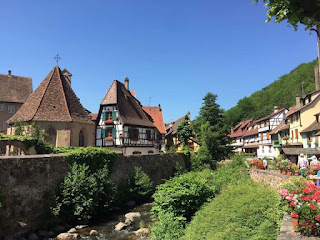
In the historical town of Kaysersberg, in Alsace, northeastern France

 "Nothing more excellent or valuable than wine was ever granted by the gods to man." -- Plato

================================================================

(in northeastern France) Kaysersberg, "One Of The Most Beautiful Villages In France," is found in the Alsace region of France, the eastern part of the country that lies at the foot of the Vosges -- bordering both Germany and Switzerland, one of the loveliest regions of France. Known for its Route du Vin, the most famous wine route in France, a marked series of roads that meander through pretty little wine villages with colorful half-timbered buildings and castles perched on hilltops. The route is just over 100 miles (160 km) long,, starting just west of Strasbourg, with the Rhine River that borders Germany to the east and the Vosges mountains to the west, then heads south towards Colmar and beyond to Mulhouse. Just 10 km (~6 mi.) northwest of Colmar, Kaysersberg is quite a heart-stopper with its backdrop of gently sloping vines, hilltop castle, and old fortified bridge spanning the rushing Weiss River. You will also find other historical monuments as you explore Kaysersberg, many dating from the 15th century, such as the towers, bridge and ramparts, and the 16th century Town Hall, each adding their own bit to the charm of the town. From many parts of the town you can see the ruins of the Chateau de Kaysersberg (the castle) poised high on the hill above it. An important route passes through the valley here (the Col du Bonhomme) that has been defended since Roman times, with the castle being built in the 13th century. In the centuries since, this remained a prosperous town (apart from the years around the time of the Thirty Years War).


Timeless Half-Timbers and Riverside Romance: A Journey Through Esslingen am Neckar 🇩🇪

  (in the city of Esslingen am Neckar, Germany)   If you are looking for a destination that captures the soul of medieval Germany without ...