Tuesday, 5 April 2022

In the city of Madrid, capital of Spain

 "Nobody goes to bed in Madrid until they have killed the night."

― Ernest Hemingway, Death in the Afternoon
==================================================================
(in central Spain) The city of Madrid, capital of Spain, is the political, economic and cultural center of the country. Madrid was officially made the national capital by Philip III, a generation after Philip II moved the court to the city in 1561. Under the patronage of Philip II and his successors, Madrid developed into a city of curious contrasts, preserving its old, over-crowded center, around which developed palaces, convents, churches, and public buildings. Found at the geographical heart of the Iberian Peninsula, Madrid is situated on an undulating plateau of sand and clay known as the Meseta (derived from the Spanish word mesa, “table”) at an elevation of some 646 meters above sea level, making it one of the highest capitals in Europe. This location, together with the proximity of the Sierra de Guadarrama, is partly responsible for the weather pattern of cold, crisp winters accompanied by sharp winds. In Madrid, Europe’s highest capital city, days are crisp but bright and sunny, which means Madrileños continue to sit out at street terraces throughout the winter months and the skies are, more often than not, a bright blue color.

+ A traditional nickname for the Madrileños is gatos (“cats”), originally coined in the Middle Ages as a reference to the ability of local troops to scale castle walls. It would be no less apt as a reference to the local lifestyle and the late hours kept by the city’s inhabitants. Madrid is a city that, with its style and flair, absorbs and holds those who live here. Its inhabitants have a reputation for being quite dearly attached to it; in the words of a local proverb, “From Madrid to heaven, and in heaven a little window from which to see it.”
+ If Madrid feels a bit like a fairytale to many of tourists, that may be because so many of the city's buildings have a confectionary, castle-like look to them. Even the City Hall is astounding, with its white pinnacles and neo-Gothic features. An architecture-focused tour can begin by the great bear statue in the central Puerta del Sol. Wander by the fanciful Royal Palace before absorbing the natural beauty of Retiro Park, then visit one of the city’s many art museums. (Artistry can also be found on your plate and in your glass, so close out each day sipping Spanish rioja while seriously sampling some tapas.)


At Olavinlinna Castle in the town of Savonlinna,southeast Finland

 “A lake is the landscape’s most beautiful and expressive feature. It is earth’s eye, looking into which the beholder measures the depth of his own nature.”

-- Henry David Thoreau
=================================================================

(in the heart of the Saimaa lake region, in the southeast of Finland) Savonlinna is a town in the heart of the Saimaa lake region, which is is also nicknamed the "Capital of Saimaa." Together with Mikkeli, it is one of the largest towns in the South Savonia region (The town is internationally known for its medieval St. Olaf's Castle and the annual Savonlinna Opera Festival.) A town built on a chain of islands surrounded by a lake, Savonlinna is one of the best places to experience the peace and gracefulness of Finland’s Lakeland. Lake Saimaa is the largest one in Finland and home to the Saimaa ringed seal -- an endangered species that is only found here.

+ The area of Savonlinna is also a paradise for anyone who enjoys nature. At Linnansaari National Park you can find some of the best lakeland scenery in Finland and it’s also where you can try to spot the Saimaa ringed seal. The best way to explore the area is by canoe or boat in summer. In winter, tour skating -- which is meant to cover longer distances and is different from regular ice skating -- is the best way to cross the frozen lake.

+ Olavinlinna Castle is a medieval three-tower castle in Savonlinna. It is built on an island in the Kyrönsalmi strait that connects the Haukivesi and Pihlajavesi lakes. Built in the 15th century, the castle was originally named St Olaf’s Castle (by a Danish noble called Erik Axelson Tott). The castle was historically a key strategic fortress along the former border of the Swedish and Russian Empires. Over the centuries it changed hands between the two empires several times after bloody medieval battles were fought on its grounds. These days, Olavinlinna Castle is a heritage protected national icon in Finland. The castle dates back to when Sweden and Russia strengthened their borders with castles and fortifications. In the Middle Ages, Sweden controlled most of present-day Finland until the Great Northern War of 1714-1721, when Sweden lost its position of power. By 1743, the castle became a Russian border fortification. From 1855 to 1861, the castle's military role ceased, and it served as a prison from 1855 to 1861. By the 1870's, the castle was beginning to be transformed into a historical monument. The northernmost medieval stone fortress still standing, the castle forms a spectacular stage for the world famous Savonlinna opera festival, the largest opera venue in Finland. (Built in 1475, the castle is yet known for its excellent acoustics.) The first opera was held in the castle in 1912 at the behest of Finnish soprano opera singer Aino Ackte. (In addition to the festival, the town of Savonlinna hosts a number of other forms of live music, art, and theater.)


In the town of Colmar, northern France

 Colmar was apparently the inspiration for the village in the Disney film, Beauty and the Beast, and walking through its streets today is a bit like imagining childhood fairytales come to life. Here, there’s a wooden turret that would be perfect for Rapunzel (to let her hair down from), tiny cottages that would make the ideal home for seven dwarfs, and a candy-colored bakery that Hansel and Gretel would surely want to frequent.

=====================================================================
(in northeastern France) The town of Colmar, in the cultural region of Alsace, is located 42 miles (~67 km) southwest of Strasbourg, and 10 miles (16 km) west of the Rhine River; it borders the German frontier, a few miles east of the foothills of the Vosges Mountains. The first mention of Colmar is found in a chronicle of the Saxon wars of Charlemagne, emperor of the West (from 800–814). In 1226 Colmar was elevated to the status of an imperial town by the Holy Roman emperor Frederick II, and was surrounded by defensive walls. Civil rights were granted to it by Rudolf of Habsburg in 1278. In 1632, during the Thirty Years’ War, it was occupied by Sweden. Louis XIII of France took the town under his protection in 1635; it was later conquered by France under King Louis XIV in 1673 and officially ceded by the 1679 Treaties of Nijmegen. In 1854, a cholera epidemic killed many in the city. With the rest of Alsace, Colmar was annexed by the newly formed German Empire in 1871 as a result of the Franco-Prussian War and incorporated into the Alsace-Lorraine province. It was returned to France after World War 1, pursuant to the 1919 Treaty of Versailles, but was annexed by Nazi Germany in 1940, and then reverted to French control after the battle of the "Colmar Pocket" in 1945.

+ Colmar’s many fountains, ancient churches, and Alsatian Renaissance houses have made it a center of tourism. The Musée d’Unterlinden, formerly a convent, houses the 16th-century Isenheim Altarpiece, the masterwork of the German religious painter Matthias Grünewald. The home of the sculptor of New York City’s Statue of Liberty, Frédéric-Auguste Bartholdi (who was born in Colmar in 1834), is a local museum.

+ Colmar is the quintessential Alsatian town, brimming with traditional restaurants and surrounded by vineyards and medieval castles. Officially launched as a tourist trail in 1953, the Alsace Wine Route winds its way lovingly through 170 km of hills and vineyards from the north to the south of the region. It passes through almost 70 winegrowing villages (including the town of Colamar), where some 1,000 wine producers look forward to welcoming you to share their passion for wine. As you make your way through the vineyards, and stroll around charming villages, scramble over castle walls, meet winegrowers (and learn about their skills), taste the wines of Alsace at a sensory workshop, or bask in the luxury of a spa with views over the vines -- you can surely to make your stay tin the area quite a memorable one indeed!


In the town of Saint Moritz lies in the Oberengadin, Switzerland

 There are some 400,000 horse races happening worldwide every year, but "White Turf in St. Moritz" is the only race taking place on a frozen lake.

===================================================================
(in the southeastern corner of Switzerland) The town of Saint Moritz lies in the Oberengadin (Upper Inn Valley) and is surrounded by magnificent Alpine peaks. The town consists of the Dorf (village), the Bad (spa), and the hamlets of Suvretta and Champfèr. Originally known for its curative mineral springs, it became a fashionable spa and summer resort in the 17th century. Since the late 19th century, it has developed as one of the world’s most famous winter-sport centers and was the scene of the Winter Olympic Games in 1928 and 1948. Still known as the largest winter sports region in Switzerland, St. Moritz enchants visitors with its breathtakingly beautiful landscape, its legendary glamor, and its harmonious balance of nature and tradition.

+ Winter Alpine holidays were invented in St Moritz more than 150 years ago by the British, and many other resorts have since imitated its formula of snow and fun. The Maharajah of Hyderabad once arrived at his hotel in St Moritz with 500 trunks and 300 pieces of hand luggage. Ballet dancer Nijinsky gave his last public performance in the ballroom of the Suvretta House and other bygone guests to the hotel include such diverse figures as the Shah of Iran, Eva Peron, and Vladimir Lenin. (The early visitors skated on the frozen lake and tobogganed on a steep slope that was to become the Cresta Run.)

+ Switzerland's original winter wonderland and the cradle of Alpine tourism, St Moritz has been luring visitors since 1864. With its aquamarine lake, emerald forests, and beautiful mountains, the town looks irresistable. Yet, despite all the designer boutiques on Via Serlas and celebrities on the pistes, this resort isn't all about show. Its real riches are found in the mountains, with superb carving on Corviglia, black runs on Diavolezza, and miles of hiking trails (when the snow melts). Though St Moritz has hosted the Winter Olympics twice, many visitors are surprised to learn that the town first gained fame due to its mineral springs, discovered some 3,000 years ago -- establishing it as a summer spa resort. Cable cars ascend to three nearby mountaintops. Hundreds of miles of ski trails and the frozen lake comprise the area's most popular sports venues. Follow the Romans example and try one of the city's mineral springs, such as St. Moritz Bader.

+ Although originally known as a summer destination, when the first snowflakes land in St. Moritz, so do the international scenesters, bundled in their "must-have" accessories. (During winter, catch a ride on the Glacier Express from Zermatt to arrive in style.)

+ Provided here is a snapshot of horse racing on the frozen lake in St. Moritz. White Turf is a legendary horse race that has attracted many fans for more than a century. It is unique in many respects, the most obvious being the (natural) consistency of the "turf."


Sunday, 20 March 2022

On the edge of the Swabian Jura of central Baden-Württemberg, in Germany

 "The greatest and noblest pleasure that men can have in this world is to discover new truths; and the next is to shake off old prejudices." ― Frederick II, also known as Frederick the Great (the King of Prussia who belonged to the Hohenzollern dynasty and went on to become the longest ruling monarch from his dynasty)

===================================================================
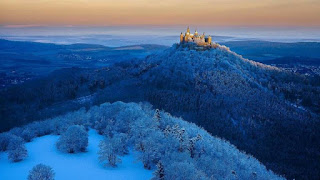
(on the edge of the Swabian Jura of central Baden-Württemberg, in Germany) Baden-Württemberg (commonly shortened to BW or BaWü) is a federal state (Bundesland) in southwest Germany, east of the Rhine River, which forms the southern part of Germany's western border with France. (What is now Baden-Württemberg was formerly the historical territories of Baden, Prussian Hohenzollern, and Württemberg.)

+ Mount Hohenzollern, in BaWü, is topped with the famous Hohenzollern Castle. In nearby Ulm, the swift-flowing blue Danube forms the boundary in the south, while the Neckar runs past half-timbered towns, limestone crags, beech woods, juniper-cloaked heaths, hilltop ducal castles and robber-knight ruins further north. The region is considered a geologist’s dream -- 200 million years ago it had more volcanoes than almost anywhere else on earth. The karst landscape is riddled with caves, where rare fossils and ice age art (including the 30,000-year-old Löwenmensch, on display in Museum Ulm) have been discovered. In 2017, the Swabian Jura Caves and ice age art received UNESCO World Heritage status for having some of the world's oldest figurative art, dating from 43,000 to 33,000 years ago. (This is where the castle's residents hid when enemies were at the gate.) On these stones the Hohenzollern dynasty was built. Here, at the base of the castle, the first stone was laid some 1,000 years ago. Four floors higher, one can see what they made of it. The hall depicting the family tree of one of Europe's most powerful ruling families, includes the names of monarchs and the nobility, stretching from floor to ceiling -- highlighting names like Frederick the Great, the soldier king Frederick William I, and Kaiser Wilhelm II. (indeed, the castle primarily serves as a monument to this prestigious dynasty.

+ By the time the House of Hohenzollern had been named the rulers of the German Empire, the family had an opulent royal seat worthy of a kaiser. The third version of the castle, which stands today, was constructed for King Frederick William IV of Prussia between 1846 and 1867. The castle was built under the direction of architect Friedrich August Stüler, who based his design on English Gothic Revival architecture and the Châteaux of the Loire Valley. The castle was built as a family memorial, thus, no member of the Hohenzollern family was in permanent or regular residence when it was completed. (The winters in these parts were long and severe, meaning the owners limited their presence here to short, official visits.) In 1945 it became home to the last German/Prussian Crown Prince -- Wilhelm - who is buried here with his wife, Crown Princess Cecilie.


In the city of Aix-en-Provence, north of Marseille, southern France

 "We live in a rainbow of chaos" -- Paul Cézanne

=================================================================
(in southern France) The city of Aix-en-Provence (or simply, "Aix") is found about 30 km (~19 mi) north of Marseille. A former capital of Provence, Aix lies just one mile (~1.6 km) from the right bank of the Arc River -- on the crossroads of main routes to Italy and the Alps. The Roman proconsul Sextius Calvinus built a huge entrenched camp here (called Aquae Sextiae) about 123 BCE. Nearly two decades later, the Roman general Marius routed the Teutons at the Battle of Aix. The Visigoths, Franks, Lombards, and Muslim invaders from Spain successively plundered the town. As the medieval capital of Provence, governed by the counts and dukes of Anjou, Aix flowered as a center of learning and the arts. Its university was founded in 1409 ,and recognized by papal bull in 1413. In 1486 Provence passed to the French crown, and Aix became the seat of a parlement (a provincial appellate court of the Kingdom of France)

+ North of the tree-lined cours Mirabeau (one of Europe's great boulevards) lies the Old Town with Roman ruins and structures of the Middle Ages around the archdiocesan Saint-Sauveur Cathedral. To the south is the “new” town, rich in fine 17th- and 18th-century houses, surrounded by recent urban growth. The mineral-rich hot springs (most noted is the Thermes Sextius) are still used for rheumatic and vascular diseases. Serene, sun-dappled, and fountain-splashed, Aix is an agricultural center, noted for Provençal olives and almonds from the countryside -- painted by Paul Cézanne, whose atelier (studio) is preserved as one of several city museums.

+ A pocket of left-bank Parisian chic deep in Provence, Aix is mainly an upscale city, its leafy boulevards and public squares lined with the 17th- and 18th-century mansions, punctuated by gurgling fountains. Imposing stone lions guard its grandest avenue, the cafe-rich cours Mirabeau, where fashionable Aixois pose on polished pavement terraces, sipping espresso. (While Aix is a student hub, its upmarket appeal can make it seem a bit pricier than other Provençal towns.) No streetscape better epitomizes Provence’s most graceful city than the 440 meter-long, fountain-studded cours Mirabeau, a street sprinkled with Renaissance hôtels particuliers (private mansions) and crowned with a summertime roof of leafy plane trees. It was laid out in the 1650s and later named after the Revolutionary hero the Comte de Mirabeau. (Cézanne and Zola hung out at Les Deux Garçons, one of a string of busy pavement cafes.)

+ One of Aix' great charms is its historical center: ramble through it, drinking in divine streetscapes as you decide which historical, cultural or culinary highlight to sample next. Featured here, is the graceful cours Mirabeau (the city's main artery), to the south of which is the 17th-century Quartier Mazarin -- home to some of Aix’ finest buildings and streets (including the Place des Quatre Dauphins, ennobled by a baroque fountain of the same name).


In the town of Rothenburg ob der Tauber, south central Germany

 "Wherever you go, go with all your heart." – Confucius

================================================================
(on the Romantic Road in Bavaria, in south-central Germany) The town of Rothenburg ob der Tauber ("Red castle above the Tauber") is found on a plateau above the deep valley of the Tauber River, on the scenic “romantic route” between Würzburg and the Bavarian Alps. First mentioned as Rotinbure in the 9th century, Rothenburg developed around a Hohenstaufen fortress and was a free imperial city from 1274 until 1803. It attained its zenith under burgermeister (mayor) Heinrich Toppler (from 1373 - 1408), but declined after the Thirty Years’ War, during which it was besieged and captured (in 1631) by Catholic League forces under Johann Tserclaes, Graf (count) von Tilly. At that time the city was (allegedly) spared when a citizen accepted a dare from the enemy to drink more than three quarts of wine in one gulp (the tankard is featured in the collection of the Imperial City Museum). The event is commemorated every Whitsuntide (the seventh Sunday after Easter) by the performance of a play, Der Meistertrunk (“The Master Gulp”). The city is encircled by many-towered walls and is one of the best-preserved medieval cities in Germany. Landmarks include the Gothic and Renaissance City Hall with a Baroque arcade and the church of St. Jacob.

+ A true medieval gem, Rothenburg ob der Tauber is quite a popular tourist stop along the Romantic Road. With its web of cobbled lanes, old houses and towered walls, the town is considered the archetypal fairy-tale microcosm of Germany. Urban conservation orders here are perhaps the strictest in Germany -- and at times it feels like a medieval theme park -- yet, in the evenings, when the lamplight casts its spell long after the last tour buses have left, the place seems even more attractive -- without all the daytime "distractions."
+ In the year 1274, Rothenburg was accorded privileges by King Rudolf of Habsburg as a Free Imperial City. Three famous fairs were established in the city and in the following centuries, the city expanded. In the late 1870s, the citizens of the city and the Knights of the Hinterland built the Franziskaner (Franciscan) Monastery and the Holy Ghost Hospital, which were incorporated into the city walls. The German Order began the building of St. James' Church, which the citizens have used since 1336. The Heilig Blut (Holy Blood) pilgrimage attracted many pilgrims to Rothenburg -- which. at the time, was one of the 20 largest cities of the Holy Roman Empire.


In the capital city of Blegrade, Serbia

BELGRADE — WHERE RIVERS, EMPIRES AND HISTORY COLLIDE Some cities are defined by their monuments. Others are defined by their atmosphere. Bel...