Friday, 10 May 2024

At the Viking Triangle, a cultural and heritage area in the heart of Waterford City in southeast Ireland

 Waterford is a city and county that combines ancient history, modern culture, and stunning scenery.

====================================================================
(in County Waterford in southeast Ireland). Waterford city is situated on the Suir River about 17 miles (27 km) from where the river enters the sea. Practically the entire city is built on the south bank of the river. The Old Town, now the business center, clusters behind the broad quay-front on a low-lying strip of land left behind by a gentle loop of the river at this point.

+ As the oldest city in Ireland, Waterford boasts a rich Viking heritage that can be explored in the Viking Triangle, where visitors can see the medieval Reginald's Tower, the Bishop's Palace, and the Waterford Crystal factory. Waterford is also a lively and vibrant place, with a thriving food scene, local festivals, and charming shops. If you want to escape the city, you can enjoy the beautiful countryside and coastline of Waterford county, where you can cycle along the Waterford Greenway, relax on sandy beaches, or visit historic sites like Lismore Castle and the Copper Coast.

+ Located within the province of Munster at the head of Waterford Harbor, it is the oldest and the fifth most populous city in Ireland. It is also the 9th most populous settlement on the island. According to the 2022 census, 60,079 people live in the city, with a wider metropolitan population of 82,963.

+ Historically the site of a Viking settlement, Waterford's medieval defensive walls and fortifications include the 13th or 14th century Reginald's Tower. The medieval city was attacked several times, and earned the motto Urbs Intacta Manet (the untaken city), after repelling one such 15th century siege. Waterford is known for its former glassmaking industry, including at the Waterford Crystal factory, with decorative glass being manufactured in the city from 1783 until early 2009 when the factory closed following the receivership of Waterford Wedgwood plc. The Waterford Crystal visitor center was opened, in the city's Viking Quarter, in 2010 and resumed production under new ownership. As of the 21st century, Waterford has served as the county seat of County Waterford, and the local government authority is Waterford City and County Council.

+ Today, Waterford is a city and county that combines ancient history, modern culture, and stunning scenery. As the oldest city in Ireland, it boasts a Viking heritage that can be explored in the Viking Triangle, where you can see the medieval Reginald's Tower, the Bishop's Palace, and the Waterford Crystal factory. Waterford is also a vibrant place, with a thriving food scene, local festivals, and charming shops. If you want to escape the city, you can enjoy the beautiful countryside and coastline of Waterford county, where you can cycle along the Waterford Greenway, relax on sandy beaches, or visit historic sites like Lismore Castle and the Copper Coast.

+ Shown here is Viking Triangle, a cultural and heritage area in the heart of Waterford City:


In the capital city of Maastricht, Netherlands

 "...[The Maastricht Treaty] was not the end of history. It was a first step towards a Europe of growth, of employment, a social Europe...."

-- Laurent Fabius
====================================================================
(in the Netherlands) Touching Belgium on its west and just a few miles from Germany to the east, Maastricht is the capital of Holland’s southernmost region, Limburg. A city rich in history and culture, Maastricht has the second highest number of national heritage buildings in the Netherlands, after Amsterdam. The city boasts two great town squares: Vrijthof, with Sint-Servaas Church, Sint-Jan's Cathedral and Markt, home to the Town Hall and a fantastic vendor market. (The city’s Old Town fortifications, are another popular draw.) Mount Saint Peter is largely situated within the city's municipal borders. Adjacent to the border with Belgium, Maastricht is part of the Meuse-Rhine Euroregion, an international metropolis, which includes the nearby German and Belgian cities of Aachen, Liège, and Hasselt.

+ Developed from a Roman settlement, Trajectum ad Mosam (“Ford on the Meuse”), to a medieval river trade and religious center, in the 16th century Maastricht became a garrison town -- and in the 19th century an industrial center. Today, the city is a thriving cultural and regional hub. (It would later become the birthplace of the euro.) The city is visited by tourists for shopping and recreation, and has an international student population.) Maastricht houses several beautifully designed buildings, some of which are rare European churches. Aside from this, there is a much to do in the city -- including a visit to the treasures of Saint Servatius.

+ Attacked on the first day of the German invasion of the Low Countries in 1940, Maastricht was the first Dutch town to be liberated, in 1944. Following a 1991 meeting of the European Communities that was held in Maastricht, an accord, known as the Maastricht Treaty was signed, which called for the establishment of a European Union -- with common policies on economic foreign affairs, security, and immigration.

+ Attacked on the first day of the German invasion of the Low Countries in 1940, Maastricht was the first Dutch town to be liberated, in 1944. Following a 1991 meeting of the European Communities that was held in Maastricht, an accord (known as the Maastricht Treaty) was signed, calling for the establishment of a European Union, with common policies on economics, foreign affairs, security, and immigration. Maastricht’s landmarks now include the St. Servatius Bridge over the Meuse, the Dinghuis, or former courthouse, and the Town Hall. The cathedral, dedicated to St. Servatius, was founded by Bishop Monulphus in the 6th century; it is the oldest church in the Netherlands, although rebuilt and enlarged from the 11th to the 15th century. The Protestant Church of St. John originally served as its parish church. There are many other medieval churches, as well as fine houses in regional Renaissance and French styles.


In the Italian style village of Portmeirion in Gwynedd in North Wales

 Sir Bertram Clough Williams-Ellis was a Welsh architect known chiefly as the creator of the Italianate village of Portmeirion in North Wales. He became a major figure in the development of Welsh architecture in the first half of the 20th century.

====================================================================
(in the Italian style village in North Wales) Portmeirion is a tourist village in Gwynedd that lies on the estuary of the River Dwyryd River in the community of Penrhyndeudraeth. Portmeirion was designed and built by Sir Clough Williams-Ellis between 1925 and 1975 in the Baroque style, and is now owned by a charitable trust.

+ Set on its own tranquil peninsula reaching into the estuary, this fantastical collection of colorful buildings with a heavy Italian influence was masterminded by Welsh architect Sir Clough Williams-Ellis. Starting in 1925, Sir Clough collected bits and pieces from disintegrating stately mansions and set them alongside his own creations to concoct this weird and wonderful seaside utopia. Today the buildings are all heritage listed, the site is a conservation area, and festivals, fairs, gigs and other events are frequently held here.
At the age of 90, Sir Clough deemed Portmeirion to be complete -- 50 years after he began. It is really more like a stage set than an actual village, and it formed the ideally surreal set for cult TV series The Prisoner, which was filmed here from 1966 to 1967. It still draws fans of the show in droves, with rival Prisoner conventions held annually in March and April. (The giant plaster-of-Paris Buddha, just off the piazza, was featured in the 1958 film The Inn of the Sixth Happiness, starring Ingrid Bergman.) 
A documentary on Sir Clough and Portmeirion screens on the hour in a building just above the central piazza.  

+ Sir Clough's lifelong concern was with the whimsical and intriguing nature of architecture, his raison d'être to demonstrate how a naturally beautiful site could be developed without defiling it. His life's work now stands as a testament to beauty, something he described as "that strange necessity." He died in 1978, having campaigned for the environment throughout his life. He was a founding member of the Council for the Protection of Rural Wales in 1928 and served as its president for 20 years.

+ Most of the quirky cottages and scaled-down mansions scattered about the site are available for holiday lets (the Unicorn building, with its faux-Georgian facade, offers great views over the central village), while other buildings contain cafes, restaurants and gift shops. Portmeirion pottery (the famously florid tableware designed by Susan, Sir Clough's daughter) is available, even though these days it's made in Stoke-on-Trent (England). A network of walking paths thread along the coast and through the forested private peninsula, which includes the ruins of a castle (a real one, not one of Sir Clough's creations) and a profusion of exotic plants,


Sunday, 14 April 2024

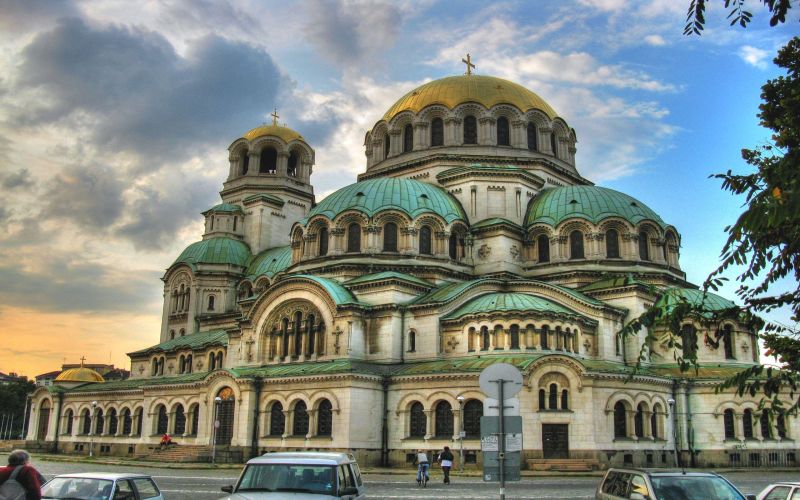
At the St. Alexander Nevski Cathedral, city iof Sofia, capital of Bulgaria

 "... Sofia tends to charm its visitors into lingering here indefinitely."

--Stephanie Craig
=====================================================================
(near the geographical center of the Balkans region) The city of Sofia, famous for being one of Europe's oldest capitals, reflects the influence of other cthat of ultures like the Greeks, Arabs, Jews, and others. The city's most popular attractions are its massive houses of worship. (Visitors tend to love these places because they exude a peaceful atmosphere.) Found in the Sofia Valley at the foot of the Vitosha mountain, Bulgaria's capital is west of the Iskar river and has many mineral springs, such as the Sofia Central Mineral Baths.

+ Known as Serdica in antiquity and Sredets in the Middle Ages, Sofia has been an area of human habitation since at least 7000 BCE. The recorded history of the city begins with the conquest of Serdica by the Roman Republic in 29 BCE from the Celtic tribe Serdi. During the decline of the Roman Empire, the city was raided by Huns, Visigoths, Avars and Slavs. In 809, Serdica was incorporated into the Bulgarian Empire by Khan Krum and became known as Sredets. In 1018, the Byzantines ended Bulgarian rule until 1194, when it was reincorporated by the reborn Bulgarian Empire. Sredets soon became the cultural, administrative, economic, and literary hub (i.e., until its conquest by the Ottomans in 1382.) From 1530 to 1836, Sofia was the regional capital of Rumelia Eyalet, the Ottoman Empire's key province in Europe. (Bulgarian rule was restored in 1878. (Sofia became the capital of the Third Bulgarian State in 1879.). Vast parks and manicured gardens now offer the ski slopes and hiking trails of mighty Mt Vitosha are but a short bus ride from the city's center. Home to many of Bulgaria's finest museums, galleries, restaurants and clubs, Sofia may persuade you to linger longer too (to learn much more about this place.) During the 6th century Byzantine influence increased, which later gave the town its name,

+ Liberated from Byzantine rule from in1878, Sofia nd was designated the Bulgarian capital in April 3, 1879. Since the end of WWII, a agricultural zone characterized by fruit and vegetable growing (and by dairy farming) now surrounds Sofia.

+ Among the many educational institutions in Sofia are the Bulgarian Academy of Sciences, the Academy of Agricultural Sciences, and the University of Sofia (the oldest establishment of higher learning in Bulgaria). The city also contains the Cyril and Methodius National Library, the Ivan Vazov National Theater and Opera House, an astronomical observatory, and several museums. In addition to the restored St. George, Boyana, and St. Sofia churches, historical monuments include two mosques, one housing a fine archaeological collection, and the St. Alexander Nevsky Cathedral, erected to commemorate the gratitude of the Bulgarian people to the Russian liberators of 1878.

+ Shown here is Sofia's St. Alexander Nevski Cathedral, the oldest church in the Bulgarian capital:


In the island of Mont-Saint-Michel-Michel, in Normandy, France

 "A saint is a person who gives of his [or her] self without asking for anything in return. That's how simple it is to be a saint."

-- Edward James Olmos
=====================================================================
(In Normandy, France) Rising above the sea like a castle in a fairy tale, Mont Saint-Michel (shown here) is one of France's most-visited sights. Legend says the archangel Michael, the island's namesake, repeatedly appeared to Bishop Aubert of Avranches in dreams, telling him to build a church on top of the island in 708 CE. Since its completion, it has become an important pilgrimage site for Christians and European intellectuals. Visitors can tour the fascinating abbey and admire its incredible medieval architecture or wander its surrounding streets, which are lined with small shops and quaint cafes.

+ One of France’s most iconic images: the slender spires, stout ramparts, and rocky outcrops of Mont St-Michel rising dramatically from the sea – or towering over slick, shimmering sands laid bare by the receding tide. Despite vast numbers of tourists, both the rock-top abbey and the narrow alleys below still manage to transport visitors back to the Middle Ages.

+ This island, with its fast and fickle tides, was a notorious prison during the French Revolution. Today, visitors arrive (by choice), seeking to explore the 11th-century abbey, dine in fine restaurants, and take in the impressive evening illuminations. Only a narrow causeway, built in 1880, linked the island to the mainland, -- although a convenient bridge was completed here, a little more than a decade ago.

~ Mont-Saint-Michel, a rocky islet and famous sanctuary in the Manche department of France's Normandy région, lies just off the coast of Normandy. It is located 41 miles (66 km) north of Rennes and 32 miles (52 km) east of Saint-Malo. Around its base are medieval walls and towers above which rise the clustered buildings of the village -- with the ancient abbey crowning the mount. (One of the more popular tourist attractions in France, Mont-Saint-Michel was designated a UNESCO World Heritage site in 1979.)

+ Mont-Saint-Michel-Michel is almost circular (about 900 meters in circumference); it consists of a granite outcrop rising sharply (to 78 meters]) out of Mont-Saint-Michel Bay (between Brittany and Normandy). Most of the time it is surrounded by vast sandbanks and becomes an island only when the tides are quite high. Before the construction of the causeway that now connects the island to land, it was particularly difficult to reach because of quicksand and very fast-rising tides. Yet, the causeway has become a barrier to the removal of material by the tides, thus resulting in higher sandbanks between the islet and the coast.


In the city of Genoa (Genova), a port city and the capital of northwest Italy's Liguria region

 "By prevailing over all obstacles and distractions, one may unfailingly arrive at his chosen goal or destination. -- Christopher Columbus

====================================================================
(in the center of the Italian Riviera) Genoa, Italy's largest seaport in this city is known for the many beautiful buildings it houses -- which provide many examples of Renaissance, Baroque, and Gothic architecture. Aside from this, the city is also known for embodying its maritime traditions that guests can witness when they visit.

+ Located about 75 miles (120 km) south of Milan on the Gulf of Genoa, the city occupies a narrow coastal plain and the western slopes of the Apennine Range. In part, due to its mild Mediterranean climate, shipbuilding is Genoa's major industry, which helps to make it a major center for finance and commerce. The port of Genoa leads all other Italian ports in volume of passengers and freight traffic and is the main source of city income. It handles imports chiefly of coal, crude oil, and grain and exports mainly of cotton and silk textiles, olive oil, and wine.

+ Genoa was the birthplace of Christopher Columbus (in1451), who embodied the active maritime tradition of the city. It is noted for its many examples of medieval, Renaissance, Baroque, and Gothic architecture. The Ducal Palace, San Lorenzo Cathedral, Church of San Matteo, and Palazzo San Giorgio are some of the most important historical monuments. The Palazzo Bianco and the Palazzo Rosso are the two largest picture galleries; Edoardo Chiossone Museum of Oriental Art and the Cathedral Treasury have extensive medieval collections. The Via Garibaldi and the Palazzi dei Rolli, are the first European examples of an urban development project that was designated a UNESCO World Heritage site in 2006. The University of Genoa is an important center of higher learning in northern Italy. The city also has several colleges and a school of navigation.

+ Genoa is linked with the major cities of Italy, France, and Switzerland by railway and highways. Its port serves as the chief outlet for the agricultural and industrial products of northern Italy and much of central Europe. Cristoforo Colombo International Airport, situated 4 miles (6.5 km) west of the city, provides domestic and international flights.

+ This city and its port can seem full at once of grandeur, sparkling light and deep shade. A gateway to the Riviera for travellers today its weighty architectural heritage speaks of its former glory; the Most Serene Republic of Genoa ruled over the Mediterranean waves during the 12th to the 13th centuries -- and history feels alive in Genoa -- especially in its Old City, still a reminder of premodern life, with its maze of narrow streets largely intact. Emerge from this thrilling heart to Via Garibaldi and the Enlightenment-era gold-leaf halls of the Palazzi dei Rolli. In the heart of the city lies Piazza de Ferrari, a main square with a beautiful fountain and historic buildings like the Palace of the Doges the Teatro Carlo Felice.


Saturday, 13 April 2024

In the city of Sibiu, the historical region of Transylvania, in central Romania

 "How good and thoughtful he is; the world seems full of good men--even if there are monsters in it."-- Bram Stoker

=====================================================================
(in the historical region of Transylvania, in central Romania) Sibiu, a fortified medieval town, is located some 275 km (~171 mi.) northwest of Bucharest; it straddles the Cibin River. Now the seat of the Sibiu County, it was (between 1692 and 1791 and 1849–65) it was the capital of the Principality of Transylvania. +Sibiu is a charming city in the heart of Transylvania, where history and culture blend harmoniously with modernity and nature. Sibiu boasts a stunning Gothic cathedral, a splendid Baroque palace, and a fascinating ethnographic museum that showcases the rich and diverse heritage of Romania. Sibiu is also a city of towers, each with its own story and personality, offering panoramic views of the Old Town and the surrounding hills. Sibiu is a great destination for those who love art, architecture, and adventure, as well as for those who want to discover the authentic and vibrant spirit of Transylvania.

+ Sibiu is found on the north side of the Turnu Roșu (“Red Tower”) Pass, which links Transylvania to southern Romania across the Transylvanian Alps (Southern Carpathians). It was initially a Daco-Roman city called Cedonia. Its later Latin name, Cibinium, was derived from that of the river, a tributary of the Olt, which rises in the Cibin Mountains southwest of the city. Sibiu was refounded by Saxon (German) colonists in the 12th century as Hermannsdorf (later Hermannstadt). The old medieval town is in two parts, the upper town built on a terrace and the lower town on the banks of the Cibin, the two being connected through an old district by narrow, cobbled alleys called the Fingerling Stairway.

+ Massive brick walls erected around the upper town gave it the nickname “Red Town,” for the color of the walls, which repelled Turkish attacks in the 15th and 16th centuries. During that time, Sibiu was an important craft and cultural center of the German communities in Transylvania, boasting 19 guilds in 1376. In 1541 Transylvania became an autonomous Turkish vassal state; but, as the Turks later withdrew from Hungary, Austria regained Transylvania in 1699. Sibiu then became the military center of Transylvania and, on two occasions (1703–91 and 1849–65), the capital. (It was ceded to Romania in 1918.)

+ Of the 40 watchtowers on the original inner city wall, three remain -- the octagonal tower of the carpenters, the square tower of the potters, and the pentagonal tower of the cloth makers. Also in Sibiu are a massive Lutheran cathedral (built in the 13th and 15th centuries), an Orthodox cathedral (built 1906, modeled on Hagia Sofia in Istanbul), and an 18th-century Roman Catholic church.
+ Sibiu's Old Town (shown here) has a distinctly Germanic feeling. Sections of the medieval wall still guard the historic area, before opening into vast, church-dominated squares -- and the Bidge of Lies).


In the most enchanting town of Bamberg, northern Bavaria, Germany

BAMBERG: Germany’s Fairytale City of Seven Hills, Rivers, and Timeless Beauty. (in the most enchanting town of Bamberg, northern Bavaria, ...