Friday, 29 October 2021

In the town of Viana do Castelo, in the Norte Region of Portugal

 "Life is what we make of it. Travel is the traveler. What we see isn't what we see, but what we are." -- Fernando Pessoa

==================================================================

() The town of Viana do Castelo, seat of the district of Viana do Castelo, is located on the Portuguese Way, an alternative path of the Camino de Santiago, at the mouth of the Lima River. The jewel of the Costa Verde (Green Coast), Viana do Castelo is blessed with an appealing medieval center, an attractive riverfront, and lovely beaches -- just outside the city. The old quarter showcases leafy 19th-century boulevards and narrow lanes crowded with Manueline manors and rococo palaces, all dramatically presided over by the pearly white, neo-Byzantine Santa Luzia church (depicted here) on the hilltop high above town. The town’s setting, by the Rio Lima estuary, makes Viana a great base for exploring the lower Lima valley. One of the most beautiful sanctuaries in Portugal, and the most charismatic symbol of the region, the Sanctuary of Santa Luzia attracts many tourists who traverse its beautiful interior, until they reach the top and can marvel at the spectacular views over the landscape below. Indeed, there are two good reasons they visit Viana’s 228-meter eucalyptus-clad hill, known as Monte de Santa Luzia. One is the wondrous view down the coast and up the Lima valley. The other is the fabulous, neo-Byzantine Templo do Sagrado Coração de Jesus. where they seem to feel just a little bit closer to heaven by climbing to the zimbório (lantern tower) atop its dome, via a lift, followed by a narrow stairway.


At Lake Como, in Lombardy, Italy

 “A lake carries you into recesses of feeling, otherwise impenetrable.”

-- William Wordsworth
==================================================================

(in Lombardy, Italy) Lake Como, also known as Lario, is the third largest of the Italian lakes (after Lake Garda and Lake Maggiore). With a maximum depth of approximately 410 meters, Lake Como is one of the deepest lakes in Europe. The mountain-backed shores are furrowed with ancient paths that wind through attractive villages, where for the price of a cappuccino you can while away a sunny afternoon watching beautiful people. Many of the historic palaces open their rooms and gardens for public viewing, enabling visitors to experience history vicariously -- like a former duke or duchess. A beautiful spot that makes for a convenient day trip from Milan, Lake Como is known as "home-sweet-home" to Hollywood star George Clooney. It is also known for natural beauty, elegant old villas, and the scenic towns that surround the lake. Check out Varenna, Bellagio, and Menaggio, which offer great views, historic churches, and water-based activities, such as ferries and passenger-only boats. Its lush lakeshore vegetation includes vines and fig, pomegranate, olive, chestnut, and oleander trees. The lake is famous for the natural beauty of its setting and for the handsome villas on its shores. (Lake Como is associated with the classical writings of Virgil, the two Plinys, and Claudian.) Among the many noted lakeside resorts are Como, Lecco, Bellagio, Tremezzo, Menaggio, and Varenna (featured here). Located on the eastern shore of Lake Como, Varenna is a lovely, traditional village, of ancient origins. The main sights here are the Castello di Vezio, a small museum dedicated to Lariosaurus (a Middle Triassic sea reptile related to turtles), as well as the beautiful gardens at Villa Monastero, which include a botanical garden, a museum, and a convention center.


In the group of Åland Islands, Finland

 “We shall be permitted to live on this planet only for as long as we treat all nature with compassion and intelligence.”

― Aldous Huxley, Island
================================================================

(in Finland) The group of Åland Islands is an archipelago at the entrance to the Gulf of Bothnia in the Baltic Sea belonging to Finland. It has been an autonomous (and demilitarized) region of Finland since 1920 by a decision of the League of Nations, and its only official language is Swedish. The islands lie at the entrance to the Gulf of Bothnia, 25 miles (40 km) east of the Swedish coast, at the eastern edge of the Åland Sea. The archipelago consists of about 35 inhabited islands, 6,500 uninhabited islands, and many rocky reefs. Åland, the largest island in the group, accounts for more than 70 percent of the total land area and is known locally as Fasta Åland (“Main Island”). Åland is home to about 90 percent of the archipelago’s population and is the site of Mariehamn, the island's main seaport, and only town. From the 19th century until World War II, Mariehamn served as the center of a sailing fleet engaged in grain trade with Australia. Few of these ships still operate, though the colorful history of the fleet is reflected in an excellent maritime museum. The town of Mariehamn is the capital of Finland’s Swedish-speaking autonomous territory, i.e., the entire archipelago. The people of Mariehamn, and Åland in general, lead a laid-back islander lifestyle and welcome visitors quite warmly. Mariehamn, like many of the coastal towns in Finland, comes to life in the summer. It is easy to get around on foot or by bike, as Mariehamn lies on a peninsula with harbors on either side. (It’s also only a 10-minute walk from the West Harbor to the East Harbor.) If you’re in the mood for shopping, Sjökvarteret (Maritime Quarter) is the place to find local crafts, silversmiths' workshops, and a marina for traditional wooden ships and boats.


In Bodnant Gardens, near Tal-y-Cafn, in Conwy, Wales, UK

 “When the world wearies and society fails to satisfy, there is always the garden.” – Minnie Aumonier

===============================================================

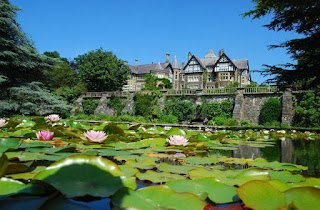
(near Tal-y-Cafn, in Conwy, Wales, UK) Nestied in the Snowdonian foothills of North Wales, Bodnant Garden was forged by the Victorian vision of an extraordinary man, then honed by his descendants -- and is still today cherished by visitors the world over. Established in 1874 by scientist, businessman, and politician Henry Pochin, he and his family filled the garden with plants collected by famous global explorers such as Ernest Wilson, George Forrest, and Harold Comber. Laid out in 1875 and painstakingly landscaped over 150 years, Bodnant is one of Wales’ most beautiful gardens. Lord Aberconway of the McLaren family (which once lived in the gracious late-18th-century abode [featured here] at the heart of Bodnant) bequeathed the lush 32-hectare (~79 acre) property to the National Trust in 1949. Formal Italianate terraces overlook the River Conwy and Snowdonia's Carneddau Mountains, and rectangular ponds creep down from the house into the orderly disorder of a pretty wooded valley and wild garden. Cared for by the National Trust since 1949, Bodnant is a garden of firsts -- home to the earliest and grandest laburnum arch built in 1880, to Britain’s earliest magnolias introduced from China in the late 1800s and to unique rhododendron hybrids which originated here from the 1920s. Today, Bodnant Garden is home to exotic plants from the Blue Poppy of the Himalayas to the Fire Bush of the Andes, as well as five National Collections -- of Magnolia, Embothrium, Eucryphia, Rhododendron forrestii and Bodnant Rhododendron Hybrids. It is also boasts Wales’ largest collection of UK Champion Trees, which provide their won year-round spectacle. In Spring, visitors enjoy swathes of daffodils, camellias, magnolias, and rhododendrons; the heady sight and scent of roses, lily ponds, herbaceous beds and buzzing wildflower meadows in Summer; a kaleidoscope of rich leaf color in Autumn; and sparkling, frosted landscapes in Winter.


In the city of Sicily, Italy

 “All of Sicily is a dimension of the imagination.” -- Leonardo Sciascia

===============================================================

(in Italy) Sicily, the largest island in the Mediterranean Sea, is an autonomous region of Italy that includes numerous smaller isles. It is separated from the mainland region of Calabria by the five kilometer (~3 mi.) Straits of Messina. Sicily is blessed with great art and along history; from Agrigento’s Valley of the Temples to Palermo’s Baroque churches, and a home at various times, to every great Mediterranean civilization. The island’s distinctive geological feature is Mount Etna, Europe’s tallest active volcano. Featured here is the town of Taormina in eastern Sicily, on a hill rising almost perpendicularly from the sea, at the foot of Monte Tauro between Messina and Catania. Founded in the 4th century BCE, Taormina enjoyed great prosperity under the Greek ruler Gelon II and later under the Romans, but fell into quiet obscurity after being conquered by the Normans in 1087. Its reincarnation as a tourist destination dates to the 18th century, when northern Europeans discovered it on the "Grand Tour." Among its fans was D.H. Lawrence, who lived here between 1920 and 1923. There are also remains of the Roman Odeon theater here, discovered during excavations in 1892, and of the so-called Naumachia (a reservoir). The famous Greek theater, rebuilt in Roman times, stands on the spur of Monte Tauro, affording a splendid view of Mt. Etna to the southwest and the mountains of Calabria across the sea to the north. The cathedral and the Corvaja, Santostefano, and Ciampoli palaces date from the medieval period. Volcanic Mount Etna and the Ionian Sea provide the cinema-worthy backdrop for Taormina, Sicily's legendary resort town. Twisting medieval streets and a 2nd-century Greek theater add to its romantic air, which inspired the writings of D.H. Lawrence (and Truman Capote). Take a cable car to the beach, or walk uphill behind the Church of St. Joseph for panoramic views.


Thursday, 21 October 2021

In the city of Rastatt, Baden-Württemberg, Germany

 Although uprisings in Germany during the late 1840s were suppressed by the forces of reaction, their ultimate goals were eventually realized. Baden had been the scene of the first of the 1848 uprisings in Germany, which helped to set the stage for the rise of a more modern, unified Germany, in 1871 .

=================================================================

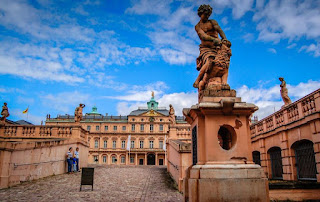
(in the German state of Baden-Württemberg) A city with a baroque core, Rastatt is found in the Upper Rhine Plain on the Murg River, six kilometers (~4 mi.) above its junction with the Rhine. An important place associated with the early-18th-century War of the Spanish Succession (the Treaty of Rastatt was signed here), as well as the Revolutions of 1848/1849 in the German states. Until the end of the 17th century, Rastatt held little influence, but after its destruction by the French in 1689, it was rebuilt on a larger scale by Louis William, margrave of Baden, the imperial general in the Habsburg-Ottoman War, known popularly as Türkenlouis. It then remained the residence of the margraves of Baden-Baden until 1771. It was the location of the First and Second Congress of Rastatt, the former giving rise to the Treaty of Rastatt. In the 1840s, Rastatt was surrounded by fortifications to form the fortress of Rastatt. For some 20 years prior to 1866, it was occupied by the troops of the German Confederation. The Baden revolution of 1849 began with a mutiny of soldiers at Rastatt in May of that year under Ludwik Mieroslawski and Gustav Struve, and ended here a few weeks later with the capture of the town by the Prussians. For years afterwards, Rastatt remained one of the strongest fortresses of the German empire, but its fortifications were dismantled in 1890. Between 1946 and 1954, about 20 major criminal proceedings (known as the Rastatt Trials) for crimes against foreign workers and prisoners in smaller camps in the National Socialist camp system in southwest Germany took place in front of the French Military Administration's Tribunal Général, along with more than 2,000 defendants. Today, Rastatt and its surrounding area -- in the vicinity of the Black Forest and the French border -- is home to a variety of historical buildings, including palaces and castles such as Schloss Rastatt and Schloss Favorite. Featured here is Schloss Rastatt, a historical structure in Rastatt. The palace and the garden were built between 1700 and 1707 by the Italian architect Domenico Egidio Rossi, as ordered by Margrave Louis William of Baden. During the Palatinate War of Succession (from 1736-1742), the residence of Margrave Louis William of Baden-Baden had been burned by French troops. A rebuild of the destroyed building would not have suited the representative needs of the court of Baden-Baden. Since he also needed a home for his wife Sibylle Auguste of Saxe-Lauenburg, whom he had married in 1690, the Margrave had a new residence built in place of the former hunting lodge. During this operation, the 1697 hunting lodge was demolished to leave space for the new palace.


In the town of Pays de Caux, in the Normandy region of northern France

 “A garden to walk in and immensity to dream in -- what more could he ask? A few flowers at his feet and above him the stars.”

― Victor Hugo, Les Misérables
===============================================================

(on the coast of the English Channel in the Pays de Caux, in the Normandy region of northern France) The Pays de Caux is an area in Normandy occupying the greater part of the French département of Seine Maritime. Tucked away on the Alabaster Coast, just 12 miles (~19 km) southwest of Dieppe, the lovely village of Veules-les-Roses is a cluster of half-timbered cottages and lots of ancient charm. The Veules, which flows through the village, is France’s shortest river. Its water is used in ponds for growing watercress, from which it finds its way to the sea through a gap in the high chalk cliffs that overlook a sand and pebble beach. One of the oldest villages in the Pays de Caux, Veules-les-Roses became a popular holiday resort in the 19th century, cherished by artists such as Victor Hugo. Today, a pleasant, laid-back atmosphere makes Veules-les-Roses quite a delightful seaside retreat, brimming with local restaurants specializing in fresh fish and oysters. Many of the houses at Veules-les-Roses are still maintained as they were when built several centuries ago. Many with thatched roofs, the old but well maintained houses, and their fascinating layout, make the village a memorable place to explore on foot. (There are several walking paths in the village. Most of them start at the beginning of the village and snake through the village.) Considered to be one of the oldest villages in the Pays de Caux, the seaside hamlet of Veules-les-Roses has been inhabited since the 4th century and is now highly regarded as one of Normandy’s prettiest places. The village is nestled on the banks of the Veules, which winds its way past historic thatched cottages and watermills down to the shore where the famous Veulaise oysters are harvested -- and a pretty little beach is flanked by dramatic cliffs.


In the most enchanting town of Bamberg, northern Bavaria, Germany

BAMBERG: Germany’s Fairytale City of Seven Hills, Rivers, and Timeless Beauty. (in the most enchanting town of Bamberg, northern Bavaria, ...